
SB2C-3 Helldiver (1:48 Revell Monogram)
|
|
|
|
Painting & Detail |
|
|
 I checked the tone of blended color with the help of my friend Mr. Emile Hasegawa. |
|
|
 This is the kit original propeller. |
 Propeller blades were from Tamiya P-47. Both were equipped Curtiss Electric prop, so it's no problem. |
 The hinge cover was scratched. The left is original kit. |
 Finished. |
|
|
 Surfacer was finished. Then the surface of paint was polished by #1500 grid sand paper. |
 Two sliding canopy was masked and covered with surfacer. |
 The first coat of tricolor. Then the surface was polished by #1500 paper again. |
 Some details were added on the rudder. |
 The close up of windshield. Please note the trapezoid fairing panel. |
 Blu Tack was used for the gradation of boundary at the time of airbrushing. |
|
|
 Ribs were glued to prevent from distortion. |
 This is the inside of the upper diving brake. |
 Color was Mr.Hobby RLM23 Red. |
|
The intermediate portion of the gear was the 3.0mm brass pipe. The oleo-pneumatic shock absorber was the 2.0mm pipe. The lower curved portion of the gear was the 1.8mm brass rod. Kit's gear cover parts were not so good shape. Kit's leg cover was a little wide and tall. Also, kit's wheel cover was a little wide and short. |
 The right parts is combination of the 3.0mmA2.6mmA2.0mm pipes and the left one is 1.8mm rod. |
 Finished. The thickest portion was the 3.3mm pipe on the 3.0mm pipe. |
 The towing ring was 0.5mm brass rod. The torque link was from Tamiya P-47D. |
 The tire parts sandwiched 0.8mm plastic sheet. |
 The tread pattern was engraved by the handmade jig and photo-etching saw. Please note the supporting guide plate (center). |
 The center two parts are corrected parts (dark portion are added portion), and the left and right parts are kit original (red portion should be cut). |
 The back side ribs were different. The left is kit original part and the right is corrected part. |
 Some details were added on the landing gear. The red rod was 0.35mm brass rod. |
 The width of the brake line was two-step. The thicker line was made of annealed 0.5mm brass rod and the thin one was elongate spur. |
 The wheel hub was painted interior green. |
|
|
 Intersecting points were trimmed each other. |
 The antenna was made of the 0.4mm and 0.6mm brass rods. |
|
Please refer this site for Yagi antenna.
|
 The wooden mold and heat pressed 0.5mm plastic sheet. |
 The pilot seat was scratchbuild. The back of the seat wasn't curved. The right one was kit part. |
 The 0.30 cal. Browning guns were basically kit parts. Some details (small holes on the barrel etc.) were added. |
 Seatbelt buckles were of Finemold's photo-etching. Belts were made of lead sheet. |
 The radar instruments were basically kit parts. |
|
|
 The national insignia was masked and airbrushed. Be careful that the size of kit's decal wasn't correct. |
 Markings were masked and airbrushed. |
|
|
 Shading was depicted by the airbrush. |
 Chipping work was applied by the fine brush. |
 |
 Propeller blades were heavily weathered. |
|
|
 Caution data were dry-decal. |
 These are customized dry-decal. |
|
|
 The bomb rack was made of brass rod and plastic sheet. |
 Antenna line. |
|
|
Completion |
|
After nine months of struggle, my Helldiver finally completed. I worked an average of one hour per day, so it took almost 270 hours or so. I consumed so much materiel - three boxes of SB2C-4 kit, one Tamiya P-47, one Hasegawa P-40E, True-Details resin (not in use), Moskit exhaust pipe (not in use), Aeromaster SB2C data decal, customized dry-decal and so on. |
 The cockpit set of True Details. |
 That's all. It's too late to use. |
|
|
 |
|
|
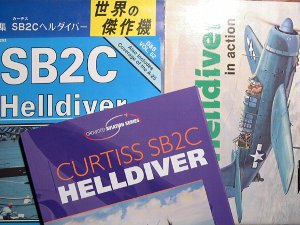
| 1 | The famous aircraft of the world (old edition) | Bunrindo |
| 2 | The famous aircraft of the world (new edition) | Bunrindo |
| 3 | Helldiver Units of World War 2 (Combat Aircraft) | OSPREY |
| 4 | SB2C Helldiver in action Aircraft No.54 | Squadron/Signal Publications |
| 5 | D&S Vol.52 SB2C Helldiver | Squadron/Signal Publications |
| 6 | Curtiss SB2C Helldiver | Crowood Press |
| 7 | Dauntless Helldiver | DTU |
| 8 | Scale Aviation Magazinevol.17 (Jan.2001) | Dainippon-kaiga |
|
Web sites |